Saturday, August 13, 2011
Louie Palu photos and essay
Navy Corpsmen try to save an Afghan girl
Monday, June 20, 2011
CERP spending
Sunday, June 19, 2011
Evaluating U.S. Foreign Assistance to Afghanistan-- A Two Part Complaint
"...we believe the administration can be more effective in how it spends aid in Afghanistan. U.S. assistance should meet three basic conditions before money is spent: our projects should be necessary, achievable, and sustainable." (page 2).
I wonder who wrote those two sentences? They are classic. Let's pause for one moment and examine the thesis of this incredible piece of work.
First, it says the administration can be more effective in how it spends aid. What does that mean, exactly? That the money should get more 'bang' for each 'buck'? For example, for every dollar spent, Afghans should get 60 cents in actual assistance -- like meals, water, roads and so forth? Because one OXFAM report claims that something like 40% of foreign assistance is returned to the country of initiation in salaries and payments to project managers and monitors from that country. OR, does that sentence mean that for every dollar spent we should see a resulting decrease in violence in any given area? Or, does that mean that for every dollar spent, the Afghan markets grow by some proportional amount? Or, perhaps it means that for every dollar spent, we should be able to get out of there faster? Or maybe that we have quicker mechanisms for spending the money? Congress appropriates it one day, and it's spent within a week or two? or...? No clear acknowledgement or recognition that money is being spent in Afghanistan in an incredibly complicated context strikes me as irresponsible.
Next, it says that "U.S. assistance should meet three basic conditions before money is spent: our projects should be necessary, achievable, and sustainable." Should US assistance be necessary, achievable and sustainable? Or should projects be necessary achievable and sustainable? Those are two separate things. Here's why.
First, let's look at assistance. Let's say the authors are trying to say that assistance should be necessary, achievable and sustainable. That would imply that there would be clear goals, objectives and programmatic for spending aid money in Afghanistan, which I can tell you is not happening. So, for a project like the District Delivery Program (which I have first hand knowledge of and which was a project to build sub-national governance), before spending money, USAID should have established what the overarching goal was, what the intermediate objectives were, and then how to determine whether those goals were met and the timeline for taking those measurements. If they did this, it was in secret. And I'm pretty sure that although there is some programmatic language for the billions that are being spent in Afghanistan, measures are not really measuring effects. Dear reader, you and I could dream up a great-sounding programmatic justification for spending money in Afghanistan. Delivering the results is quite another monster all together. Who knows if the planned actions are achievable in a war zone being conducted in a fourth world nation. And CERTAINLY the assistance is not sustainable by the Afghan government because that's why it's called assistance. If the Afghan government had enough money to spend on all the development international donors are supporting, then we wouldn't need to assist. Right? Or am I missing something here. Hopefully we are not giving money to countries that don't need assistance.
Next, let's look at the assertion from the standpoint that it means that projects should be necessary, achievable and sustainable. In a fourth world country, where literacy is about 25%, and life expectancy is about 45 years old, any spending can be justified. Any at all. The Afghans need everything. And the more we give, the more they need. What are we trying to achieve by all this giving? Well, that depends. In a lot of cases, we give because it makes us feel good. Soldiers spend money because they are shocked by the conditions, or because a local village leader buttered up a Marine and next thing you know the market has some brand new toilet facilities. USAID spends money because they are told to do so. They are being goaded, prodded and pushed into 'supporting the military' as they say in country. So, let's say all the expenses over the past year in Helmand province were to a) make us feel good, and b) show USAID support to military actions. Did they succeed? Well, you could go there and ask around--ask soldiers and aid workers if they felt good, and ask the military if USAID is spending dollars in support of operations. I think you would find positive results. So, the spending could right away be called necessary and achievable just based on those two justifications--feel good-ism and supporting the military. Are projects sustainable? No, because they are foreign assistance. We just went over that. Are the projects that are being constructed achievable? Yes, most everything is achievable, and very little is not getting completed. From cell phone towers to market toilets to roads to water turbines, projects are being completed all across Afghanistan.
The thesis for this report is askew and politically motivated. The report goes on to make many other circular claims. Like this one, on page 2. Most of the assistance is being spent on short term stabilization programs (undefined, of course). Notice the words "short" and "term". One paragraph later it complains:
"The evidence that stabilization programs promote stability in Afghanistan is limited. Some research suggests the opposite, and development best practices question the efficacy of using aid as a stabilization tool over the long run."
Notice the conflation of applying "development best practices" and "stabilization over the long run". And refer back to the discussion about how most money is being used for stabilization in the short run. So, if it's being used for short term gains, then what's the problem and why is the next paragraph discussing "development best practices" as if that's what is going on?
Another example of circular logic is here:
"The administration is pursuing an assistance strategy based on counterinsurgency theories that deserve careful, ongoing scrutiny to see if they yield intended results."
There is a confusion of reasons for spending in Afghanistan. Not all reasons are mutually exclusive. We could be spending money in a kinetic environment to, say, get a village cleaned up and the men back to doing something productive. It might also start boosting the micro-economic environment as people have a bit to spend and a small market might open up. This may be short-term gain, but it also might not be harmful to long term prosperity. It's a crapshoot. But it seems to me that the development folks are wisely questioning spending in support of a counterinsurgency campaign, but they are unwisely not questioning long term development practices as well. Because to be completely honest, we just don't know what's what and how best to spend money when in a post-conflict environment. It's all unknown and conditional.
Here's the real issue:
"There must also be unity of effort across the U.S. Government and international community. If we conclude that a civilian program lacks achievable goals and needs to be scaled back, no other actors should take over the effort. Too often, when our civilians determine that a project is infeasible, we simply transfer the program
to other actors, such as the U.S. military or other donors."
The report is more bluster than utility. All hat and no cattle.
Wednesday, June 8, 2011
Sustainability
Wow. Shock of all shocks--did we spend our tax dollars to come to this conclusion? Because they missed the question--sustainability is not The Question. The question should be: are we spending our development dollars to legitmize the Afghan government? It's all about legitimacy, not sustainability for Jimminy Cricket's sake. If you stop and examine the Afghan budget you'll find out that international donations OFF THE BUDGET account for about 82% of the total spending in Afghanistan, according to the Afghans. (And they can't really get their arms around all the spending. So it's probably more.) What does that mean? That means that for every 100 gazillion U.S. dollars donated by international donors, only 18 percent go thru the Afghan system and help build a government that can function and provide services, and the other 82 gazillion dollars go directly to contractors in the field who then do who-knows-what with it.
Normally, the sustainability mantra is leveled at DoD by the State Department and USAID, as if DoD spending is all the whole cause of "unsustainability" in Afghanistan. This is ridiculous and circular. The Development/Diplomacy community say that DoD should a) build sustainable structures, and not structures that fall down because the Afghans will be psychologically influenced (Seriously. No Joke, that's what they say.); and b) they also point to CERP spending and say that it's all unsustainable. SERIOUSLY? Here's the side of the argument that never gets discussed: there are only so many contractors in Afghanistan, and really, we are all using the same unskilled labor. USAID, for example, is building equally shaky roads, bridges and canals, buildings and so forth because we are all using the same unskilled labor! And, I'd like to know what survey shows that the Afghans will be psychologically influenced by the soundness of the development projects? The second argument is equally as bizarre. CERP spending is only a fraction of the total aid money being poured in to Afghanistan. When USAID, for example, builds a road, they also don't dump money into the ministry that is responsible for maintaining that road. Hence, the next winter/spring flood, the road washes out, and voila, the road was unsustainable, just as if CERP money had built it.
Even if you level the unsustainable argument against both the State Department and USAID and DoD all together, it still doesn't make sense. Because the bigger point that nobody wants to discuss because it's too hard, and it's much easier to wrangle among ourselves, is this question: if we don't dump money into a country like Afghanistan where there is about a 75% illiteracy rate, where people expect to live to the age of about 45, and where infant and maternal mortality rates are some of the worst in the world...then what is the alternative? I'd like to hear an alternative proposal from the development experts and the cast of staffers who concluded that aid to Afghanistan is not sustainable. (I wonder if they looked at aid to any other of the countries we assist? I'd bet they'd find out it too was not sustainable, because that's why it's called-- you guessed it-- aid. If the country could afford the programs itself, and thereby have sustainble programming, we wouldn't be giving it aid.)
Sustainability is one of those wonderful rosy terms that everyone likes to use--and of course, we can all agree that everything should be sustainable. But it's not pragmatic, and to my mind the wrong question for Afghanistan. The right question is: is our spending creating legitimacy? They are two different questions.
I'll be interested to see the Congressional report.
Tuesday, January 18, 2011
The Great "Pointing of Fingers" Game: USAID and NGOs versus DoD.
A letter to the editor appeared in response to the articles, which I have copied:
Washington Post
January 11, 2011
Military-Led Aid Projects Doomed To Fail In Afghanistan
It is no surprise that military aid projects in Afghanistan are "crumbling under Afghan stewardship" ["In Afghan hands, aid projects neglected," front page, Jan. 4]. The troops are armed with good intentions, but they often neglect basic development principles, owing to a lack of expertise on aid and mounting military and political pressures.
Afghanistan's National Solidarity Program is a better alternative. Under this proven model, called "community-driven reconstruction," local engagement and accountability are as important as bricks and mortar. Afghan staff members from agencies such as mine help organize village groups and determine what they need most and who will be responsible for the viability of a school, clinic or road. It's laborious work that emphasizes local knowledge and local ownership as well as sustained commitment - indispensable if Afghanistan development is to have any hope of success.
Military-led projects erode established humanitarian principles of impartiality and independence, fail to win hearts and minds and - we now know - are ineffective. The White House, the State Department, the Pentagon and Congress need to act on the growing evidence showing that the militarization of aid is folly.
Michael Kocher, New York
The writer is vice president for International Programs at the International Rescue Committee.
Editor's Note: The article by Josh Boak appeared in the Current News Early Bird, January 4, 2011.
The author is elegant in his ability to touch on all the "points" against DoD, making bizarre assertions based on faulty assumptions that are oft repeated. For example, in his editorial about Afghanistan, Mr. Kocher claims that "military-led projects erode established humanitarian practices...". I wonder if Mr. Kocher realizes that there is a war in Afghanistan? The military is not engaged in trying to influence the social development of Afghanistan for humanitarian reasons, but rather as a way to win the counter insurgency.
Second, the Afghan National Solidarity Program is not "proven", nor is it an alternative. Afghanistan is not a landscape that can only contain EITHER the military OR the Afghan National Solidary Program as the author seems to assert. And particularly since neither program is proven.
Finally, the conclusion that Congress et al should act on 'growing evidence' against militarization of aid is quite a leap of logic. Wait, I thought we were talking about Afghanistan?
The continued rhetoric from USAID and the NGOs against the military is provocative, for sure. However it's not neccessarily productive. What is needed is less provocation and more serious analysis and discourse about the complicated context we find ourselves in. The continued claims against the military's effectiveness at 'nation building' are well worth investigating. The pragmatic problem, however, is that there are no alternatives regardless of what any analysis would find. For example, in Afghanistan, it was my experience that USAID wouldn't work in areas which are too unsafe (undefined), and they also won't work in areas which are too safe and developed as it would be a waste of resources. Sure, the military is inefficient and cumbersome and makes mistakes. Inexpert. But what's the alternative? The cries from USAID and the NGOs would be more effective if they were backed up with an alternative course of action that is proven and effective. As the book "The White Man's Burden" describes, we have spent billions in aid and assistance, and yet the world seems no more friendly nor less impoverished.
Friday, January 14, 2011
Mortality rates decrease in Afghanistan
The New York Times has an interesting article about the reduction in mortality rates from injuries in Afghanistan.
Tuesday, December 28, 2010
The history of foreign aid: "Samaritan Diplomacy"?
Now that Christmas is done and I can start to settle in, I am doing some reading. In my travels I found the third book of Daniel J. Boorstin's series called "The Americans", the third book is called "The Democractic Experience" published in 1974. At the end of the book he discusses "Samaritan Diplomacy" and the changes in US perspective from pre-Marshall plan when aid to other nations was considered unconstitutional, to post-Marshall plan when US aid was expanded beyond war reparations and European nations to under developed nations. (It was first expanded by Truman in his "fourth point".)
Boorstin starts this section off: "For most of the nation's history, the United States remained uncomfortable, inept and on the whole unsuccessful in diplomacy." (p 568) Interestingly, one of the first acts using the military for aid came in 1880 during one of the Irish potato famines. Congress passed a joint resolution that allowed the Secretary of the navy to use a naval vessel to carry volutary (privately donated) relief to the Irish. Later, this was regarded as a regrettable stretching of the Constitution to appease the Irish-American vote.
According to Boorstin, not until the Marshall plan was there enough political justification to use American tax money to assist other nations. The confusion of motives for the aid stems from this time: "The American institution of foreign aid was a by-product of World War II. It marked a new stage in American foreign policy in which charitable, fiscal, political, ideological, and military motives would be more confused than ever before. Incidentally, too, foreign aid would newly confuse the techniques, attitudes, and institutions of peace with those of war, and so would help open an era in American foreign relations when the American people were neither at war nor at peace." (p 574) Boorstin claims that "except in religious missions, the nation had no substantial precendent for a world-wide program of foreign aid....foreign aid now expressed faith that American wealth could raise the standard of living of people anywhere. A people with a higher, more nearly American standard of living, it was assumed, would be more apt to be democratic, and hence more apt to be peace-loving and friendly to the United States. Implied, also was the complementary assumption that poverty, misery and industrial backwardness would make any people less peaceful and less democratic, hence more prone to communism, and therefore more inclined to join the enemies of the United States." Of course, the assumptions have not always born out.
In fact, this discussion gave me pause, particularly in light of the steady drum beat of the Millenium Development Goals, the political and military discourse about globalization and "haves" versus "have nots", and the confusion over the common use of the term "humanitarian aid" (for purely humanitarian reasons? or for political motives?)
Also relevant, the theory of counter insurgency calls for massive development expenditures in dangerous areas in order to create sympathies for the legitimate government, in order to assist people attain their basic life needs--water food shelter--so they feel better about their government and 'buy in' to it's legitimacy, lay down arms and stop harboring terrorists. But, as pointed out in the Washington Post front page yesterday, it's not that easy. USAID and the US State Department in Afghanistan, for example, only want the military to provide "security" so they can provide development assistance. Yet their vision of security and the military version are disparate. And sometimes discussions about where to deliver development assistance veer toward the absurd when geographical areas are deemed "too safe" for development assistance and other areas not safe enough. USAID doesn't want to deliver aid where it's unsafe, and they don't want to waste their aid on places where it's too safe. And they damn sure don't want the military to meddle in their humanitarian space (as they call the battlefield) by delivering aid or creating development projects.
Boorstin had it right. It's a confusion that is not about to go away. Are we confusing the world with our own confusion? Is "smart power" truly smart?
Saturday, October 30, 2010
Ashraf Ghani

Darted into the General's office, found the papers, darted out. The sun had sunk just below the mountain peak way off in the west. The General looked at the papers, then looked up at the mountains, and smiled and thanked me as if I had just done something important. I considered leveraging my moment of glory to ask who is Ashraf Ghani? But just as I was considering, a white pickup bristling with Afghans and guns zoomed up followed by an armored SUV. As if choreographed, the moment the vehicles slowed just enough, a beautiful man in flowing robes exited the SUV with a smile. As if Venus alighting from the Clamshell I remarked, surprised. He warmly grasped LG Rodriguez's hand and they swished in to the building for their meeting. Clearly Ashraf Ghani was someone. No, I mean Someone. Big S. A colleague passed me by on the street just then and said, that was Ashraf Ghani. He's the most wanted man in Afghanistan. What? I asked. He didn't look hunted. He looked angelic! We laughed.
Turned out Ashraf Ghani had run for president of Afghanistan, and has done so much more. He was the finance minister for Afghanistan, he is an advisor to Afghan President Karzai, and he is a reformer of international aid, former World Bank Employee. He runs the Institute for State Effectiveness. That was what my google search turned up.
Less than a month later I was in Kandahar. Kandahar has weather that you would not retire to. Dry, boiling hot and dusty. It's flat there, with odd spires of rock that protrude from the desert floor like the spines on a reptile's back. The dust is a soft powder brown and as you sweat, it sticks to you in a fine even coat. The only nice weather is at sunset when the sky turns rosy and the call to prayer meanders across the desert floor like steam from a tea cup, redolent with ancient meaning. I was down in Kandahar on business, waiting for my flight home, tired, perusing the 'donated books' shelf. My body armor already on, I felt hot, sweaty, distracted. I just needed something to read for the trip back to Kabul. Lots of science fiction floats around these donated book shelves, romance novels and other relatively unidentifiable material, mostly with eye-catching covers and little substance in between. I scanned the shelves, nothing. Then, in the very corner of a shelf I saw a hard bound book. Those are not usual, so I focused...Ashraf Ghani and Clare Lockhart "Fixing Failed States". What? Ashraf Ghani! The most wanted man in Afghanistan!! (I don't know if this is true, but of course it's the kind of thing you would remember). Gotta read it.
Here's a link to Ashraf Ghani and Clare Lockhart's Institute for State Effectiveness: http://www.effectivestates.org/. One of the themes Ashraf Ghani and Clare Lockhart return to in the book and other writing is the incoherence of the 'intervening' states' programs. By that I mean the incoherence of the aid agencies of various countries as well as the incoherence of programs between the aid agencies and the military. Generally speaking, as various donor nations seek ways to support a weak government, they take on individual programs and projects and then become protective of those programs, competitive, even. The agencies compete with each other to place 'technical advisers' in the nation's governmental organizations. The technical advisers report back to their country, promote their own programs above others and compete for time with the top ministry staff and ministers themselves. Government agencies and officials are often whipsawed between competing demands made more salient by associated programmatic funds. Many nations also pay for top up salaries to high-ranking national staff and ministers, with the richer nations creating a competitive environment for ministerial staff to play one nation against the other. The military is often involved not because of the money and expertise it brings, but because of its sheer massive size and presence. It's wasteful and generally counterproductive. And Ashraf Ghani and Clare Lockhart speak out about it. After reading the book, I wonder if Ashraf is the most wanted by aid agency staff as opposed to nefarious Afghan characters?
Here is a link to a report describing the results of an exercise conducted by the Center for American Progress that tested reforms needed in the U.S. Government's approach to nation building: http://www.americanprogress.org/issues/2009/03/swords_ploughshares.html. They
recommend, not surprisingly, that counterinsurgency and development strategy must be harmonized. But how.
Last spring, back in Kabul, the higher-ups, as senior officials are sometimes called, demanded a description of civil-military cooperation. ISAF and donor nation embassies and aid organizations all gathered together for a formalized briefing of how we all were cooperating. It looked great on the slides. The civilian diplomatic and development community were hard at work pouring billions of dollars into a financial system that can't absorb the money, and the military was diligently fighting insurgents. Meetings had been conducted, and programs were in place. It looked well.
But the problem for us to consider is whether the Afghan woman who lives in a village really could feel the difference? Could that woman really feel that their own government had finally gathered itself up and provided her electricity or water? I would guess not. Not in most places where the combined community claims to be engaged, anyhow. To be fair, there are successes--Kandahar and Helmand province, some places in the East and the West. But not the scope nor the depth of effectiveness that one might (falsely?) expect given the vast resources being poured in to the country. This is the crux of the matter, the proverbial hard-nut-to-crack. The community has not really changed enough to make it matter, even in spite of the millions of pages written and billions of dollars poured.
I'm writing a paper on this, and when I'm done I'll post the nuggets here. I don't pretend to have the all the answers, but the problem was one I lived for 16 hours a day, 7 days a week, and its glare will not leave me. I dream about this problem. So I have to write about it. Meanwhile I'm re-reading Fixing Failed States which I sent home to myself. Ghani and Lockhart probably have all the answers: at least I hope they do.
Wednesday, October 20, 2010
Back from Afghanistan
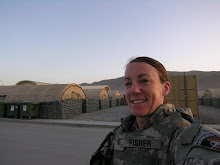
My first blog, however, must be a description of my work in Afghanistan to provide context.
Imagine a rectangle with a 1.25 mile perimeter. Fill the rectangle with generators, 16-person tents, some brick 2-story barracks, tons of large-grade grey gravel and a brick gymnasium and you now are imagining the headquarters where I and my NATO colleagues toiled for 16 or more hours a day, every day with only a few hours off every week. (A visitor to the compound once stopped me and asked me "Is the dining facility the building next to the prison?" My reply: "The prison? OH! That's not a prison, it's our command building--that's where everyone works!") The ISAF Joint Command, a newly-formed operational command hums and clicks 24 hours a day, 7 days a week. The dream child of a select group of officers, IJC (as the ISAF Joint Command is called) has a fabulously novel and famously complex structure that breaks military convention, for good reason. Instead of a normal structure where all the people who deal with transportation sit together in an isolated office, and all the people who make military plans sit in another isolated office, and all the intelligence officers sit behind several layers of barbed wire and chain link fence, the IJC has four teams of people drawn from each specialty area who work together. The four groups are planning teams that are organized according to a time horizon: Current operations, the group that monitors and makes plans on ongoing operations; Future Operations (where I worked) that planned for near-term operations; Future Operations that planned long-term operations; and then the Information Dominance Center that collected and analyzed information and fed the other three teams. (Here's an article about the structure and the Information Dominance Center: http://www.afcea.org/signal/articles/templates/Signal_Article_Template.asp?articleid=2250&zoneid=292 )
The beauty of the system is that I (a "stability planner" or Civil Affairs planner) was able to interact with the military planners, transportation planners and intelligence officers day in and day out in order to better understand the complex context of our operations. It is an incredibly information-rich and productive structure. Many officers, particularly the senior officers, have significant trouble understanding their role in this 'new' structure because it break down the rank-authority barriers to a large degree. I enjoyed this facet of the structure because it allowed me to participate more fully.
I worked on two topic areas: building sub-national governance and then at the end of my time working with the western and northern regional commands to support their governance and development operations. It was extremely fulfilling, complicated, important, and frustrating work. I loved my time there. As one of my bosses, COL Wayne Grigsby, would say "This is God's work." Amen to that.
I published an information piece in the Small Wars Journal on the subnational-governance-building piece of my work: http://smallwarsjournal.com/blog/journal/docs-temp/489-fisher.pdf
I'm writing a follow-on piece about this program.
I'm glad to be home--the air here is clean and cool, fall is just starting, there are no generators, no dust, no rocket attacks. The land here is fertile and sustaining, our lifestyles so rich and so easy. I am thankful to be an American and proud to have served with so many dedicated, determined, intelligent and thoughtful officers. I have learned to be a better person from them and the Afghans I worked with, as well as a better military officer.
Monday, July 27, 2009
Is it a battlespace or is it "humanitarian space"?
But back to the brilliant Dr. Bonventre who used to work for DoD. He apparently has been slaving away on a committee to make recommendations about how we can all get along. The report is here: http://www.usaid.gov/km/seminars/2009/civilian_military_relations.pdf. I haven't read it thoroughly yet but it looks promising.
Also, Dr. Bonventre and another brilliant former military guy, Dr. Skip Burkle, have posted their views here, on the New Security Beat blog ( http://newsecuritybeat.blogspot.com/2009/07/who-does-development-guest-contributor.html?showComment=1248726308123#c3239810732797271218).
I take issue with Skip Burkle's blog in that he views the discussion from a development perspective (the title of the blog, after all), and he maintains that USAID is best for development actions. He criticizes Secretary Gates for asking for more civilian personnel positing that Gates was asking for the personnel to be under the control of the military. Finally he criticizes DoD for be inexpert at development which he calls "winning hearts and minds" and which I would argue is "counter insurgency" when referring to Afghanistan and Pakistan. Regardless of his critique I think the question is the wrong question.
I don't think we have the luxury to have "either/or" agencies any more. I have written about this before--I think Michele Flournoy hit the nail on the head with a proposal for a new breed of security expert. Or, you could have a new breed of development expert. Either way, staff at USAID who are being paid with my tax dollars should be promoting the US Government agenda, and part of that is our national security interests. Cognizance of what that is would be a good starting point. Much like we can no longer leave military actions in these hybrid wars to the combat arms dudes who view every problem as something to shoot and kill. The world has moved on, but perhaps our gut reactions have not.
Saturday, May 9, 2009
DoD has issued several Reports to Congress
From the Report on Iraq, it looks as if progress is being made, but not very much--certainly not enough to register in public opinion (available here: http://www.defenselink.mil/pubs/pdfs/Measuring_Stability_and_Security_in_Iraq_March_2009.pdf)
Healthcare
The Ministry of Health (MoH) faces serious human resource challenges across the spectrum of healthcare professionals and ancillary staff. With Iraq’s improved security environment, the MoH has worked diligently to encourage the return of expatriate physicians; the Minister estimates that more than 1,000 physicians returned to Iraq in 2008. To increase skills, the MoH has sent 75 Iraqi medical specialists and subspecialists to various U.S. hospitals and clinics for month-long clinical rotations. Jointly, the MNF-I surgeon and the MoH are finalizing plans to rotate Iraqi healthcare providers through Coalition force hospitals and clinics throughout Iraq. The U.S. Army Corps of Engineers has transitioned 133 new Public Health Clinics to the MoH, although full potential remains limited by poor staffing and the lack of adequate essential services (i.e., electricity, water, and sewage) in some provinces.
Health awareness initiatives and responses to disease outbreaks have been very effective this year, reducing cholera cases by 80%, from 4,700 cases in 2007 to 925 cases in 2008. The MoH is also increasingly able to identify, diagnose, and treat diseases independently. Despite this initial progress, national polling indicates that only 26% of Iraqis are either somewhat or very satisfied with health services, 11 percentage points lower than in November 2007.12
If you go back and read the December version of the same report, the content is basically the same, which makes me wonder about the reporting strategy, and what kind of plan is in place to articulate what is being done vice the objectives.
And here's DoD report on Afghanistan from January 2009: (http://www.defenselink.mil/pubs/OCTOBER_1230_FINAL.pdf) Things are similarly progressing in Afghanistan, though this report does not try to tie the efforts to public opinion, oddly enough. See my other posts on Afghanistan for the similar disconnect between public opinion in Afghanistan and the gains in health care.
Here is the "health" section of the January report: (pg 71)
There are several important ideas presented in these two reports that are worth monitoring. First, that health is apparently a relatively minor contributor to stability. It seems that health is worth talking about, but not much. It strikes me as odd how much discussion in doctrine and in these reports focuses on economics, but I do not believe that there is a designated specialist in the Armed Forces' officer corps for "economist" (that's militarese for--don't think we have economists running around in uniform.) There is no clear discussion about the relative merit of the various efforts and how they might combine to affect improvements either in popular sentiment or in government capacity.The ANDS states that by 2010 the Basic Package of Health Services (BPHS) will cover at least 90 percent of the population and maternal mortality will be reduced by 15 percent. Afghanistan has made significant strides in increasing access to basic health care, and reducing overall morbidity and mortality rates. The country has seen improvements in child mortality rates and immunization rates. The MoPH developed the BPHS, a program that includes maternal and newborn health, child health and immunization, public nutrition, communicable diseases, mental health, disability, and supply of essential drugs. In September 2008, 80 percent of the population had access to the BPHS, up from 8 percent in 2001. In summer 2008 USAID and the GIRoA signed an agreement to provide up to $236 million over five years to finance additional health care services in 13 Afghan provinces, with the funds contracted and managed through internal GIRoA processes, for the first time.
Based on this precedent, the European Commission has also elected to now pass its funds through GIRoA-managed processes. In 2007, the Global Alliance for Vaccine and Immunization approved a GIRoA proposal for strengthening the health system, and awarded the Government with $34.1 million dollars between 2007 and December 2011. Current MoPH initiatives include a plan to establish 120 sub-center clinics and 80 mobile health teams. Two sub-center clinics and four mobile health teams were established in June 2008 in Kabul, Parwan, Panjshir and Kapisa
provinces.Over the next five to seven years, the MoPH will require substantial international
aid; including funding, personnel, mentoring, and assistance; to continue providing the current level of services and to develop a plan to build a self-sustaining health care system in Afghanistan.
Another interesting idea here is that DoD has to report to Congress about its goings on, but I wonder what the feedback loop is. If you read the report on Iraq, one of the brilliant successes, apparently, is that the US forces have sent 75 medical specialists to one-month rotations in US hospitals. If I were a member of Congress I would ask if that really is the most notable thing to report, and if so, what strategy are we working on here that we think that sending 75 docs to a one-month rotation was going to make substantial strides in the counter insurgency and the rebuilding of Iraq? Perhaps it is significant, but from a close read I'm not sure I get it. My concern is not so much with the content of the report as it is with the strangeness of reporting. Why report at all?
If DoD has to report to Congress about what it and the other agencies are striving to do, when is Congress and the NSC going to provide clear leadership and signal to the American public and the rest of the USG that we are at war, people are dying on our side and theirs, and a withdrawal is not the simple solution we would wish it to be. Oh wait, that would be hard work, and maybe unpopular work.
Thursday, April 2, 2009
The British are getting it right!
And, speaking of whole of government approaches....I had the good fortune to attend a conference on Irregular Warfare yesterday at the National Defense University. Although non-attributional, topics of general concern were: a) the inability of the U.S. Government to produce a whole of government approach (the discussed solution was a call for strong Congressional and Presidential mandate, tho there was a lot of sagacious anxiety that this would never come to pass since it appears as if the US as a whole is not really at war) in Afghanistan and Iraq; b) the use of special forces and general purpose forces in irregular warfare (the actual topic of the conference); c) several stabs at definitions of "irregular warfare"/"hybrid war"/"asymmetric war" with a certain amount of discussants thereafter abandoning attempts to be clear about these terms; d) the production of doctrine by the US military and the utility of that doctrine/the role of the doctrine; e) appropriate analysis of context -- a "how to suggestion" by one of the panels-- involving sociology.
It seems to me, from a purely anecdotal perspective, that sociology, anthropology and other previously dismissed "social sciences" are now ALL the vogue, with much side bar discussion about the Human Terrain Teams, their use (it was proposed that the data and knowledge it produces should be used earlier in the cycle of planning), and how to conceptualize "Irregular Warfare" from a sociological perspective. I have been in many meetings where the HTTs are discussed and whether regular intelligence units/agencies (called the G-2 in headquarters units) should incorporate this information rather than have stand-alone cells. These kinds of discussions are important and interesting, because they reflect the military's internal discussion about what needs to be institutionalized.
Then I went to an evening presentation by Dave Kilcullen on counterinsurgency sponsored by the Center for New American Security (URL: http://www.cnas.org/about) . Again, sociology played a role in Kilcullen's thinking, which is not really all that interesting in and of itself, but I was again struck by his calling out of sociological principals. Five years ago most guys in the military would not have cared a lick for sociology. Proof that the military can change is good. Kilcullen spoke in relatively broadly about what to do in Pakistan (as the real problem in Afghanistan), changes in strategy in Iraq and the magnitude of the problem in Iraq.
Charged up with coffee and all these ideas, I'm ready to tackle the world. Off to work!
Monday, March 30, 2009
Legitimacy part II
I've been doing a lot of reading about legitimacy in the political science literature because counterinsurgency doctrine demands legitimizing the established government as a method of opposing the insurgents. Democracy is founded on the idea of 'legitimate' representation. So, I began to wonder what exactly is "legitimacy"?
As it turns out there are several theoretical models of legitimacy which are usually presented in lit reviews, beginning with Max Weber. I'm not going to go through all the models, here, at least not now. The models are useful and intriguing, and describe how legitimacy is essentially a relationship between a population and a government. Legitimacy of the government can be produced via coercion, on the "less legitimate/more unstable" side of the scale, or via consent on the "very legitimate/very stable" side of the scale. So first of all, in a counterinsurgency, we want popular consent--or at least we want the slider on the scale to rest more toward the "consent" side and less toward the "coercion" side. So far so good. Nothing revelatory.
Here's what I found, though, that I think is revelatory. In a journal article from March 1990, "Legitimacy, Religion, and Nationalism in the Middle East" author G. Hossein Razi makes the case that legitimacy is actually a 2-part construct. He doesn't exactly say this--this is my summarization. First, he says there are two basic meanings: 1) that legitimacy means the set of norms and values relating to politics which are sufficiently shared so that a political system becomes possible; and 2) that legitimacy deals with meanings of the purpose of the government, the rights and obligations of the government and the governed and the methods of selection, change and accountability of the government personnel. We normally use legitimacy with the second meaning.
And here comes my 'Ah Ha' moment. The second part of the legitimacy construct is "performance."
Razi says: "...there has been insufficient grasp of the difference between the nature and sources of legitimacy and those of performance (i.e., the production of goods and services and generation of organized instruments of physical compulsion)."(pg 71). He points out that "Success in performance areas... does not necessarily result in an increase in legitimacy....the simultaneous existence of a problem in legitimacy and a problem in performance "characterizes most of the 'crises'" of the Third World...."(pg 72)
(cite:G. Hossein Razi, Legitimacy, Religion , and Nationalism in the Middle East. The American Political Science Review. Vol 84, No. 1, March 1990. pp. 69-91)
To explain what this means in concrete terms: I was recently culling through poll data from the Asia Foundation on Afghanistan (available here:http://www.asiafoundation.org/country/afghanistan/2008-poll.php) . Although the government has performed well in health and education development, and the public recognizes the performance, the overall optimism about the way the country is going is declining. In fact, in spite of recognized gains, the public opinion about the performance of the central government has decreased from 80% positive in 2007 to 67% in 2008. (pg. 53). One would expect performance to be legitimizing by way of producing positive benefit to the people, and the people expressing satisfaction with that benefit. But this apparently not the case in Afghanistan.
It seems to me that a partial explanation is that perhaps the people of Afghanistan do not expect the central government to provide health care. First, there hasn't ever been a real central government for any meaningful stretch of time, and next, no quasi governmental agency ever provided health care. And the fact that the new government does provide health care is nice, but does not change their overall view of the government. It seems from the poll data that economic benefit is expected the most.
A second idea I had was that Afghanistan is a clientelistic political system with patrons collecting resources to dole out to their clients. Because Afghanistan has never had a health system (hence the name "reconstruction" is a fallacy), trading health benefits might not yet be widely perceived to be a useful trading tool. If it becomes a useful trading tool, then there might be commensurate importance placed on government performance in this area.
The problem here is that the use of medicine for counter insurgency and stability operations seems to not be functioning, at least this year. We know so little about legitimacy, that it is hard to posit a time frame for when development activities would actually "legitimize" the government. In fact I suspect that it's probably unique to the culture we are working with. We also don't understand the other variables in the system--I suspect that we don't even know what they are more less their relationships to each other. As with most other important questions of the day, I can say I conclude that "more research is needed."
I read another interesting journal article about health development in Guatemala that sums up everything pretty well, I think:
"Development strategies that attempt to make improvements in the lives of the rural poor without addressing the underlying structural causes of poverty serve to deflect attention away from the real needs of impoverished communities. Though the underlying ideology is that local people should have a voice in solving their own problems, the definitions of the problems and the determination of priorities are usually the prerogative of the outside agencies."
(Cite: Green, Linda Buckley. Consensus and Coercion: Primary Health Care and the Guatemalan State. Medical Anthropology Quarterly, New Series, Vol 3, No. 3, The Political Economy of Primary Health Care in Costa Rica, Guatemala, Nicaragua, and El Salvador (Sept 1989). pp 246-257.)
Monday, March 2, 2009
Public Health and Afghanistan
1. Monitor health status to identify community health problems. This would mean that Afgh needs labs. And skilled workers.
2. Diagnose and investigate health problems and health hazards in the community. This means some kind of skilled and mobile health work force.
3. Inform, educate and empower people about health issues. Some kind of communication technique/vehicle.
4. Mobilize community partnerships to identify and solve health problems. Maybe more private sector engagement in Afgh as opposed to NGOs? Don't know.
5. Develop policies and plans that support individual and community health efforts. Two levels of analysis and planning.
6. Enforce laws and regulations that protect health and ensure safety. Hard in de-centralized, tribal territories, but something to keep in mind.
7. Link people to needed personal health services and assure the provision of health care when it is otherwise unavailable. This seems to be the primary focus at the moment.
8. Assure a competent public health and personal healthcare workforce. Goes with first three points and a big problem in Afgh.
9. Evaluate the effectiveness, accessibility, and quality of personal and population-based health services. This point should have gone before point #5 in my mind. But in any case, this would take MoPH resources.
10. Research new insights and innovative solutions to health problems. Same thoughts as for #9.
I like this list because these are what the military calls "lines of effort" and imply tasks like human capacity building. Lab building. Bringing in new partners. It provides a framework for considering how to build a health system, without prescribing the steps.
Saturday, February 28, 2009
Afghanistan versus Western Perspective?
Afghanistan.
In spite of the unfortunate confluence of events and the resulting lack of blogging, I have been thinking about the intersection between health, politics and society in Afghanistan, in particular. I will be working on a 90-day USAID sponsored assessment of the US Government's health reconstruction efforts in Afghanistan. This work promises to be informative on a number of levels. I will try to blog about it as appropriate, without giving away the results and getting myself into trouble.
But first, by way of context, it strikes me that there are several fundamental ideas that should be considered in any assessment and framework for the way ahead. Here are some of my initial thoughts, culled from reading and talking with colleagues:
1. Top-down, bottom-up is the best strategy for the way ahead (I stole this from a USIP report on Afghanistan published by Seth Jones and Chris Fair who are both at RAND). Afghanistan has never had a strong central government, and from my reading, the Karzai government's efforts (as would any central government's efforts) are often viewed suspiciously. Therefore, the goal of any health reconstruction efforts must be to promote local and regional ties to the central government and demote the advancement of regional rulers who have further regionalism on their agenda. Not an easy undertaking, but one that apparently USAID and the Special Forces are using now at the provincial level. (For some good reading on this, see Sloan Mann's article on the small wars journal: http://smallwarsjournal.com/documents/79-mann.pdf. Perhaps this approach can be rolled in to a regional strategy.
2. Health care and health attitudes are somewhere pre-civil war US, I'm guessing...tho I'm not a medical historian. Basically, there is no health care system. So, a whole system has to be built. Without a strong central government. This makes me wonder about the viability of the central government's Basic Package of Health Services. The problem here is that the US Government likes to legitimize the central state, because we view the world (and desperately want the world to be) a state-based system. So, we ask the central government what needs to be done. Then we roll up our sleeves and help deliver. Unfortunately, the central government has little control outside Kabul, so this approach is problematic.
3. NGOs provide and have provided most of the care. Therefore, the public probably does not view health care as a legitimate governmental responsibility. It's something that outsiders provide.
4. The Afghan public was recently reported by an ABC poll to have turned away from a positive view of the U.S. Frankly, I'm a bit suspicious about the utility of these polls, but taking the findings in gross, it may be that the US has allied itself too strongly with the Karzai government in the public sentiment. Not sure.
Health people like to think that providing health care makes the US look good in the eyes of the populace. This is a bit naive, I'm afraid. People's sentiments are changeable, though the more stable views are pretty much driven by cultural norms. Hence application of health activities to improve public perception would necessarily have to play along cultural norms. Very tricky. But this supports the argument for bottom-up approaches. If the goal is to be well thought of in order to win the insurgency war, then we need to use current cultural norms (clientelistic, "corrupt" --in our eyes-- patrimonial systems). That implies, by logical extension, that we use health care development in these give-and-take situations to develop some amount of loyalty among the tribal divisions.
5. Everybody is in Afghanistan. (All kinds of nations, that is). Makes things complicated. Afghanistan is not divided up by ethnicity. It's divided by geography, apparently. Local power-leaders rule in geographical areas (valleys). That makes things complex, too.
6. The world economy just tanked, hence the lack of donor contributions should get worse. That means fewer resources. But this is OK, in my mind, since there is no health system, basically. Rather than focusing on hospitals and clinics, perhaps the whole of government effort could be more cheaply focused on hand washing, nutrition and basic sanitation practices. Sometimes fewer resources means more efficient expenditure.
With these points in mind, assessing the construction activities and creating a framework for the way ahead in Afghanistan should be a snap.
Tuesday, February 17, 2009
Law, Culture and Health
Anyhow, while I was poking around on the web, I came across Georgetown Law's Oneil Institute that has a global public health and law center. Here's the URL: http://www.law.georgetown.edu/oneillinstitute/index.html.
I was thinking about human rights law this weekend (doesn't everyone?), and about war. I have recently read an interesting piece by an Air Force Colonel that described the liberalization of International Law and how that affected war. So, I was thinking about how "the West" also considers war, pondering the idea that cultures also don't think of war the same way we do. It's probably not always an extension of policy by other means, to misquote Clauswitz, in everyone else's mind.
So, where am I going with all this? Well, it seems to me that the Global War on Terror, which is apparently now over somehow...according to the Obama administration...., is being articulated as a war against those who fight against the State-ordered international system. That's kind of a no-brainer, and if you step back, it's a bit startling too. But to move on, it seems to me that rushing hither and thither about the globe helping people develop their own health systems or handing out aspirins in the hope of creating healthy and stable communities might be a bit premature without a better understanding of what THEY think of health, their government and so forth.
I'm speculating, here, really. But it's as fair to speculate in this way as it is to speculate in terms of the benefits of 'health diplomacy' if one were only to focus on benefit to the other guy. Don't forget that there is a lot of gratification in doing good deeds all about.
I have strayed away from my thoughts about law, but they follow along this same vein. Law is the venue by which cultural imperatives express themselves. It would be interesting to study the changes in international health law to better understand international priorities...or at least priorities of the dominant actors in the international arena. Ah ha. Another possibility for a dissertation.
Monday, February 16, 2009
Afghanistan
Meanwhile, I'm reading up on Afghanistan. Dave Kilkullen recently testified before Congress on "AFPAK" and a shortened version of his testimony can be found on the Small Wars Journal webiste here: http://smallwarsjournal.com/mag/docs-temp/177-kilcullen.pdf.
The interesting thing about all this is the growing (thankfully) recognition that there are geopolitical influences on health. Afghanistan cannot be treated as an entity in and of itself. USAID, apparently, has just sent out an assessment team to understand what can be done in the FATA region. It strikes me that repairing a hospital or training doctors is worthwhile, but probably not really the answer. It seems to me that there has to be structural change to the societies we are working in. And the way to understand this is to ascertain what their expectations and beliefs are. Normally, we do this through the Minister of Health in order to legitimize our actions. The problem with this is that while we gain approval and legitimacy for our actions, we don't understand whether our activities will actually prove viable or not. The normal answer for this problem is to hire NGOs. While NGOs provide part of the answer, I assume, they must be met with healthy skepticism as well since some NGOs are religiously-motivated, for example.
The effort in Afghanistan will continue to take time and patience. The American people will have to be reminded of 9/11 many times in the near future, I suspect. But as Kilkullen points out, there is no way to take short cuts here. Let's hope Charlie Wilson's War made its point.